
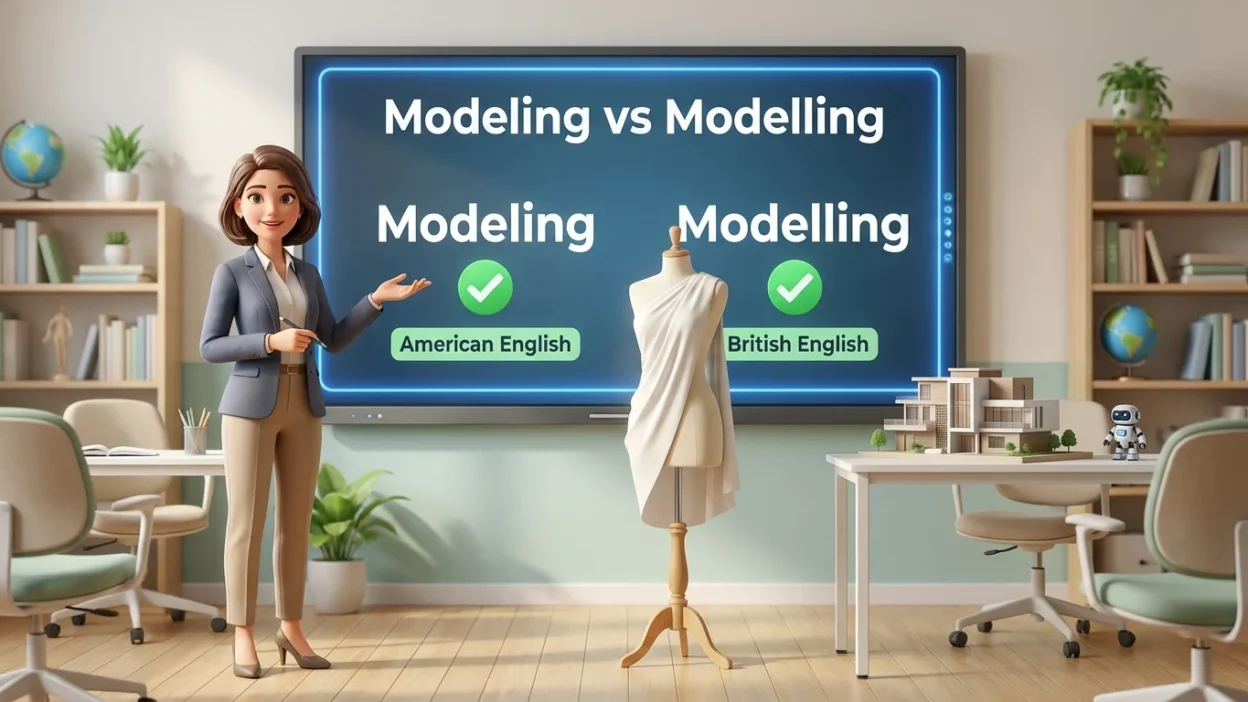
Have you ever wondered whether modeling or modelling is the correct spelling? Both versions are correct, but the right choice depends on which variety of English you are using. This spelling difference often confuses students, writers, bloggers, and English learners, especially when switching between American and British English.
The good news is that you do not need to memorize two different meanings. Modeling and modelling mean the same thing, whether you are talking about fashion modeling, 3D modeling, mathematical modeling, or the process of demonstrating a skill. The main difference is regional spelling. In this guide, you will learn when to use each version, explore practical examples, and discover simple tips to avoid common spelling mistakes.
Quick Answer: Modeling vs Modelling
Modeling is the preferred spelling in American English, while modelling is the preferred spelling in British English and many other varieties that follow British spelling conventions, including standard Australian English.
- Modeling: American English
- Modelling: British English
- Meaning: The same in both versions
- Pronunciation: Generally the same
Example: An American fashion magazine might write “fashion modeling,” while a British magazine would typically write “fashion modelling.”
Neither spelling is inherently wrong. Choose the version that matches your audience and remain consistent throughout your writing.
What Does Modeling or Modelling Mean?
Modeling and modelling are forms of the verb model. Depending on the context, the word can refer to several activities.
1. Fashion Modeling or Modelling
This meaning refers to presenting clothing, accessories, beauty products, or other items for photographs, advertisements, or fashion shows.
Examples:
- She is interested in modeling and hopes to work with international fashion brands.
- She is interested in modelling and hopes to work with international fashion brands.
Both sentences are correct. The spelling changes according to the variety of English, not the meaning.
2. 3D Modeling or Modelling
In technology and digital design, the term refers to creating a three-dimensional representation of an object, character, building, or environment using specialized software.
Examples:
- He is learning 3D modeling to create video game characters.
- He is learning 3D modelling to create video game characters.
This spelling difference applies to technical writing as well as everyday English.
3. Mathematical Modeling or Modelling
In mathematics and science, modeling involves creating a representation of a real-world situation to understand, explain, or predict its behavior.
Example: Researchers are modeling weather patterns to improve forecasts.
In British English, the same sentence would normally use “modelling.”
4. Demonstrating Behavior or Skills
The verb can also mean demonstrating a behavior, skill, or attitude that others can observe and learn from.
Examples:
- Teachers are modeling respectful behavior for their students.
- Teachers are modelling respectful behaviour for their students.
Notice that the British version also uses “behaviour” rather than the American spelling “behavior.”
Why Is It Modeling in American English but Modelling in British English?
The difference comes from spelling conventions for certain words ending in a vowel followed by a consonant.
In American English, verbs such as model generally retain the final consonant without doubling it when adding endings such as -ing or -ed.
Examples:
- model → modeling
- model → modeled
- travel → traveling
- cancel → canceled
In British English, the final consonant is often doubled in these forms when the final syllable is unstressed but the spelling convention calls for doubling.
Examples:
- model → modelling
- model → modelled
- travel → travelling
- cancel → cancelled
These are common regional patterns, although English spelling rules contain exceptions. The key point is that modeling and modelling follow established conventions rather than representing different words.
Modeling vs Modelling: Comparison Table
| Feature | Modeling | Modelling |
|---|---|---|
| Preferred variety | American English | British English |
| Meaning | Creating or demonstrating a model | Creating or demonstrating a model |
| Fashion industry | Modeling | Modelling |
| 3D design | 3D modeling | 3D modelling |
| Mathematics | Mathematical modeling | Mathematical modelling |
| Past tense | Modeled | Modelled |
| Common regional use | United States | United Kingdom, Australia, and other British-English contexts |
The table shows that the distinction is primarily about spelling. Both forms are grammatically correct in the appropriate variety of English.
Examples of Modeling vs Modelling in Sentences
Here are eight pairs of sentences to help you understand how each spelling works in context.
American English Examples
- She started modeling when she was sixteen.
- The company is modeling a new product before manufacturing it.
- Scientists are modeling the effects of climate change.
- The teacher is modeling the correct way to solve the problem.
British English Examples
- She started modelling when she was sixteen.
- The company is modelling a new product before manufacturing it.
- Scientists are modelling the effects of climate change.
- The teacher is modelling the correct way to solve the problem.
Each pair communicates the same idea. The appropriate spelling depends on the intended English variety.
Common Mistakes to Avoid
Although the difference seems simple, writers sometimes make mistakes when choosing between modeling and modelling.
Mistake 1: Thinking One Spelling Is Always Wrong
A common misconception is that modelling is a spelling error because it contains an extra “l,” or that modeling is incorrect because it does not double the consonant.
Correct understanding: Both spellings are standard. Their suitability depends on the variety of English being used.
Mistake 2: Mixing American and British Spelling
Using both forms in the same article can make your writing look inconsistent.
For example:
- Inconsistent: “She enjoys modelling, and she has modeled for several brands.”
- Consistent American English: “She enjoys modeling, and she has modeled for several brands.”
- Consistent British English: “She enjoys modelling, and she has modelled for several brands.”
Choose one spelling system and apply it consistently.
Mistake 3: Assuming the Meaning Changes
Some learners believe modeling refers to fashion while modelling refers to a technical process. This is incorrect.
Both spellings can describe fashion, 3D design, mathematics, teaching, and other activities involving models or demonstrations.
Mistake 4: Forgetting Related Spelling Differences
The same regional distinction appears in other words, including:
- traveled / travelled
- labeled / labelled
- signaling / signalling
- canceled / cancelled
Learning these patterns can make it easier to recognize American and British spelling conventions.
Which Spelling Should You Use for SEO and Blogging?
If you write blog posts, website content, educational articles, or product descriptions, choose your spelling based on your target audience.
Use Modeling for an American Audience
If your readers are primarily in the United States, use modeling. This spelling aligns with standard American English and is commonly used in American publications.
Use Modelling for a British Audience
If your readers are mainly in the United Kingdom or another audience that follows British English, use modelling.
What About International Websites?
For websites serving an international audience, consistency matters more than choosing one version as universally correct. Select a primary English variety based on your audience and follow it across your articles, headings, metadata, and examples.
Both versions may be relevant search terms, but avoid awkwardly repeating both spellings just to target keywords. Write naturally, address the reader’s question, and use the preferred spelling for your chosen audience.
FAQs
1. Is modeling or modelling correct?
Both are correct. Modeling is standard American English, while modelling is standard British English and is also used in Australian English.
2. What is the difference between modeling and modelling?
There is no difference in meaning. The difference is spelling: American English generally uses one “l,” while British English doubles the “l.”
3. Is modelling British or American English?
Modelling is the standard British English spelling. It is also common in Australian English and other varieties that follow British spelling conventions.
4. Is modeling American English?
Yes. Modeling is the standard spelling in American English and is commonly used in American fashion, science, technology, and education.
5. Is it 3D modeling or 3D modelling?
Both are correct. Use 3D modeling for American English and 3D modelling for British English.
6. Is it modeled or modelled?
Modeled is the preferred American spelling, while modelled is the preferred British spelling. Both are past-tense forms of the verb model.
7. Does modeling have one L or two?
The spelling depends on the variety of English. American English uses one “l” in modeling, whereas British English uses two in modelling.
8. Which spelling is better for an English-learning website?
Use the spelling that matches your target readers. If you teach American English, choose modeling. If you teach British English, choose modelling. You can explain both versions to help learners recognize regional differences.
Summary
The difference between modeling and modelling is a matter of regional spelling, not meaning. American English prefers modeling, while British English and many other varieties prefer modelling. Both words can describe fashion work, digital design, scientific calculations, or demonstrating behavior and skills. Related forms follow the same pattern, with modeled used in American English and modelled in British English.
When writing articles, school assignments, professional documents, or website content, select the version that suits your audience and use it consistently. Remember that neither spelling is universally better or more correct than the other. Understanding this simple distinction will help you write more confidently and recognize spelling differences across English-speaking regions.