Have you ever heard someone say a person was “three sheets to the wind” and wondered what sheets and wind have to do with anything? At first glance, this colorful English expression can sound confusing. Its meaning becomes much clearer once you understand its traditional nautical background.
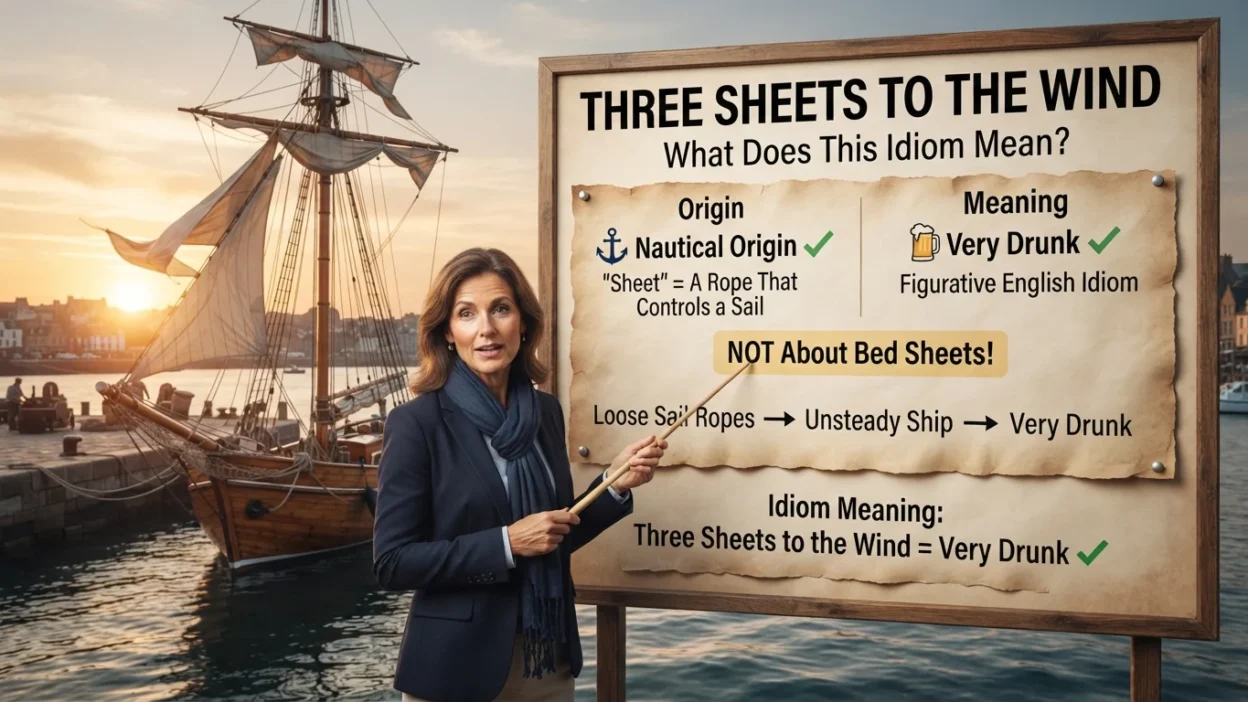
The phrase three sheets to the wind is an old idiom meaning very drunk or heavily intoxicated. It comes from sailing terminology, where a “sheet” refers to a rope or line used to control a sail rather than the sail itself. Over time, the image of an uncontrolled sailing vessel became a humorous comparison for a person who was unsteady after drinking too much. Today, the expression survives as an informal and somewhat old-fashioned way of describing drunkenness.
Quick Answer: What Does Three Sheets to the Wind Mean?
Three sheets to the wind means very drunk, heavily intoxicated, or noticeably affected by alcohol.
It is an idiomatic expression rather than a literal description.
For example:
By the end of the celebration, he looked three sheets to the wind.
The sentence means the person appeared very drunk.
Simple Meaning
Three sheets to the wind = Very drunk
The phrase can sound humorous, colorful, or old-fashioned depending on the context.
What Does Three Sheets to the Wind Mean?
When someone is described as three sheets to the wind, the speaker means that the person is noticeably intoxicated.
The expression often suggests that the person has lost some normal coordination or composure.
For example:
He arrived home three sheets to the wind.
This doesn’t involve actual sheets or wind. It simply means he arrived home very drunk.
Another example:
Everyone could tell that he was three sheets to the wind.
Again, the phrase describes someone’s condition rather than anything happening literally.
Because the expression is informal, you’ll encounter it more often in conversation, storytelling, novels, movies, and humorous writing than in formal documents.
Where Does Three Sheets to the Wind Come From?
The history of three sheets to the wind is connected with traditional sailing terminology.
One of the biggest misunderstandings surrounding this phrase is the meaning of sheet.
In everyday English, a sheet might mean:
- A bedsheet
- A sheet of paper
- A thin layer of material
But in traditional sailing terminology, a sheet is a line used to control a sail.
When such lines aren’t properly controlling the sails, the sails may move loosely and the vessel may become more difficult to manage.
This created a memorable comparison.
A sailing vessel behaving unpredictably could be compared with a heavily intoxicated person who appeared unsteady or lacking normal control.
The nautical metaphor eventually became a popular idiom.
Why “Three” Sheets?
The number three strengthens the expression and gives it a memorable rhythm.
Historically, variations involving different numbers of sheets have existed, but three sheets to the wind became the familiar fixed expression in modern English.
You don’t normally change the number when using the idiom today.
For example:
He was three sheets to the wind.
sounds natural as the established expression.
Changing it to something such as:
He was seven sheets to the wind.
would generally sound like a humorous invention rather than the standard idiom.
Three Sheets to the Wind Examples
Understanding an idiom becomes easier when you see it in context.
Example 1
He was three sheets to the wind by the end of the party.
Meaning:
He had become very drunk.
Example 2
She realized her friend was three sheets to the wind and helped arrange a safe ride home.
Meaning:
Her friend appeared heavily intoxicated.
Example 3
He sounded three sheets to the wind during the late-night conversation.
Meaning:
His behavior or speech suggested intoxication.
Example 4
The character spends half the scene three sheets to the wind.
Meaning:
The character is portrayed as very drunk.
Example 5
Nobody expected him to become three sheets to the wind at the celebration.
Meaning:
People weren’t expecting him to become noticeably intoxicated.
Three Sheets to the Wind vs Similar Expressions
Several English expressions communicate similar ideas, but their tone and strength can differ.
| Expression | Meaning | Typical Tone |
|---|---|---|
| Three sheets to the wind | Very drunk | Informal/idiomatic |
| Intoxicated | Affected by alcohol | Formal/neutral |
| Drunk | Affected by alcohol | Common/informal |
| Tipsy | Mildly affected by alcohol | Informal |
| Under the influence | Impaired by alcohol or another substance | Formal/legal contexts |
Three sheets to the wind is particularly distinctive because of its nautical imagery.
Is Three Sheets to the Wind an Idiom?
Yes.
Three sheets to the wind is an English idiom because its meaning cannot be understood simply by interpreting each individual word literally.
Consider the words separately:
Three = the number 3
Sheets = sailing lines in the historical context
Wind = moving air
But together:
Three sheets to the wind = Very drunk
That’s exactly how idioms work: the complete expression carries a meaning beyond its individual words.
Is the Phrase Literal or Figurative?
Today, the expression is primarily figurative.
When someone says:
He’s three sheets to the wind.
they aren’t saying the person is on a sailing vessel.
They’re using a metaphorical expression for intoxication.
Understanding this distinction is important because interpreting the phrase literally can make it seem nonsensical.
Common Mistakes
Mistake 1: Thinking “Sheets” Means Bedsheets
This is perhaps the biggest misunderstanding.
The sheets in the expression historically refer to sailing equipment, specifically lines used to control sails.
They aren’t bedsheets.
Mistake 2: Using the Phrase Literally
Avoid interpreting the expression as three pieces of cloth blowing in the wind.
It’s an idiom with a figurative meaning.
Mistake 3: Using It to Mean “Confused”
Being three sheets to the wind doesn’t simply mean being confused or distracted.
Its established meaning relates specifically to being very drunk.
Mistake 4: Using It in Highly Formal Writing
Because the phrase is informal and colorful, it may not fit professional, scientific, medical, or other highly formal contexts.
Instead of:
The individual was three sheets to the wind.
Formal writing would normally prefer something more precise, such as:
The individual appeared intoxicated.
Mistake 5: Changing the Wording
The standard expression is:
Three sheets to the wind
Changing the preposition or rearranging the words can make the idiom incorrect or unnatural.
When Should You Use Three Sheets to the Wind?
The expression works best in informal contexts.
You might encounter or use it in:
- Casual conversations
- Humorous descriptions
- Fiction
- Storytelling
- Movies and television dialogue
- Informal articles
- Creative writing
It is less appropriate in:
- Medical documentation
- Legal reports
- Academic papers
- Scientific writing
- Formal workplace communication
Always consider your audience before choosing an idiomatic expression.
Tone and Connotation
Three sheets to the wind often carries a humorous or playful tone.
Compared with simply saying:
He was intoxicated.
saying:
He was three sheets to the wind.
sounds much more colorful and conversational.
However, alcohol-related situations can be serious, so the humorous tone won’t be appropriate in every context.
American vs British English
Three sheets to the wind can be understood in both American English and British English.
There isn’t an important grammatical difference between the two varieties when using this idiom.
In both cases, the standard expression remains:
Three sheets to the wind
Its meaning also remains essentially the same:
Very drunk or heavily intoxicated.
Individual speakers may differ in how frequently they use the expression, and it can sound somewhat traditional or old-fashioned in modern conversation.
Related Nautical Idioms in English
English contains many expressions influenced by sailing and maritime traditions.
Examples include:
- Learn the ropes – understand how something works
- Smooth sailing – easy progress without major difficulties
- Rock the boat – cause trouble or disturb a stable situation
- All hands on deck – everyone is needed to help
- In the same boat – experiencing the same difficult situation
Like three sheets to the wind, these expressions moved beyond sailing and developed figurative meanings in everyday English.
How to Remember the Meaning
A simple memory trick is to picture an old sailing vessel with sails that aren’t being properly controlled.
The vessel moves unpredictably instead of maintaining a steady course.
Now imagine that image being used metaphorically to describe an intoxicated person’s lack of normal steadiness.
Remember:
Loose sailing control → Unsteady movement → Three sheets to the wind
This mental picture can help you remember both the meaning and the expression’s nautical connection.
FAQs
1. What does three sheets to the wind mean?
It means very drunk or heavily intoxicated.
2. Is three sheets to the wind an idiom?
Yes. It is a traditional English idiom with nautical roots.
3. Why do people say three sheets to the wind?
The expression developed from sailing terminology and became a metaphor for someone who was noticeably intoxicated and unsteady.
4. What does “sheet” mean in the expression?
In this context, sheet refers to a sailing line used to control a sail, rather than a bedsheet.
5. Is three sheets to the wind British or American?
The expression has historical English-language nautical roots and is recognized in both British and American English.
6. Is three sheets to the wind formal?
No. It is generally an informal and colorful expression and can sometimes sound humorous or old-fashioned.
7. Can three sheets to the wind mean confused?
Not normally. Its established meaning refers to being very drunk, rather than simply confused.
8. How do you use three sheets to the wind in a sentence?
You could say:
He appeared three sheets to the wind by the end of the evening.
Here, the expression means that he appeared very drunk.
Final Summary
The phrase three sheets to the wind is a colorful English idiom meaning very drunk or heavily intoxicated. Despite what its wording might suggest, the “sheets” aren’t bedsheets. The expression has nautical roots, with sheet referring to a line traditionally used to control a sail. The image of lost or loose control became a metaphor for the unsteadiness associated with intoxication.
Today, three sheets to the wind is understood in both American and British English and is mainly used in informal conversations, storytelling, and humorous descriptions. Because it can sound playful, it should be used thoughtfully when the situation itself is serious.

Liam James is a language enthusiast and content writer at Verseslay, specializing in word comparisons, grammar debates, and vocabulary insights. He helps readers understand language nuances through clear, engaging, and practical explanations.