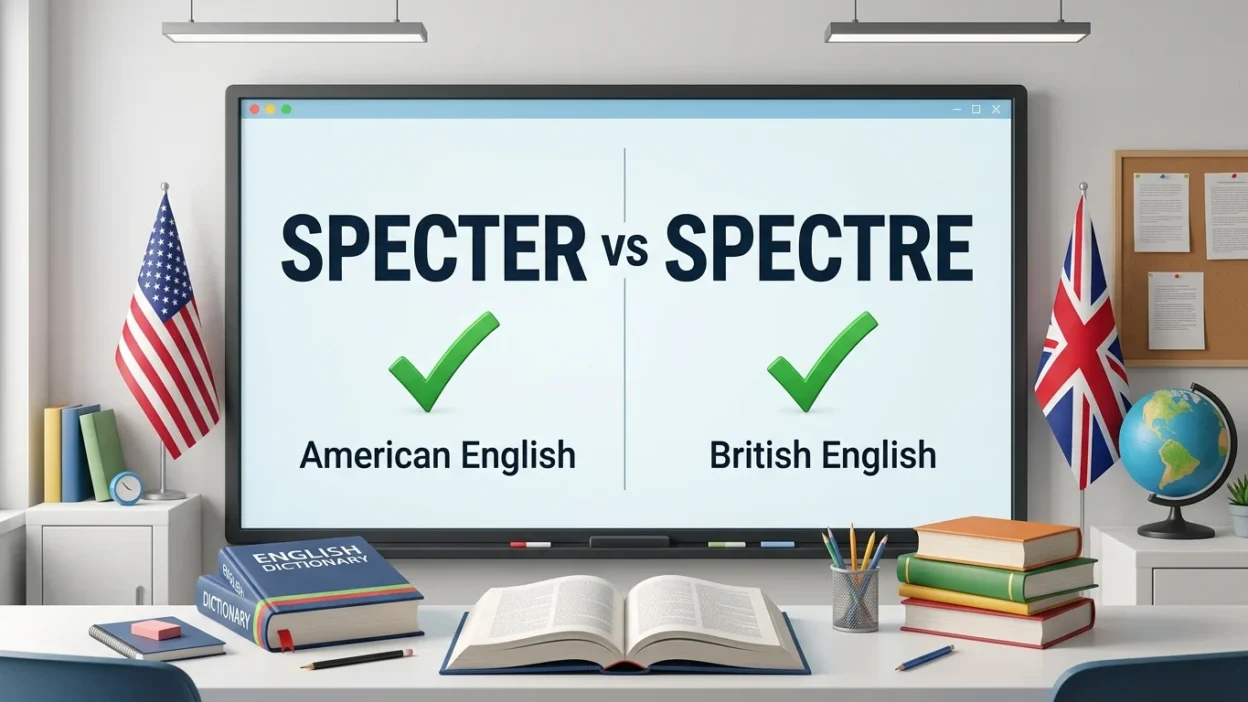
If you have ever wondered whether specter or spectre is the correct spelling, you are not alone. Both words are correct, and they have the same meaning. The main difference is where the spelling is used: specter is generally preferred in American English, while spectre is the standard spelling in British English. (Cambridge Dictionary)
Both forms can describe a ghost, phantom, or apparition. They can also refer to something frightening or unpleasant that may happen in the future, such as the specter of war or the spectre of unemployment. So, the right choice usually depends on which variety of English you are writing in.
Quick Answer: Specter vs Spectre
Specter and spectre are two spellings of the same noun.
- Specter = American English
- Spectre = British English
- Meaning: a ghost, phantom, or something feared or worrying
- Pronunciation: essentially the same
- Plural: specters in American English; spectres in British English
- Neither spelling is wrong
If you are writing for a US audience, choose specter. If your audience follows British English, choose spectre. Cambridge specifically identifies specter as the US spelling of spectre and spectre as the UK spelling of specter. (Cambridge Dictionary)
What Does Specter Mean?
Specter is a noun meaning a ghost, spirit, phantom, or apparition. In modern English, it is also frequently used figuratively for something unpleasant, frightening, or worrying that may happen.
For example, someone might talk about the specter of war, meaning the frightening possibility of war. Similarly, the specter of unemployment refers to the fear or possibility of losing employment.
Merriam-Webster defines specter as both a visible disembodied spirit and something that troubles or haunts the mind. (Merriam-Webster)
Examples of Specter
- The old castle was said to be haunted by a mysterious specter.
- The specter of war worried the entire community.
- Rising prices have created a specter of financial hardship.
- He could not escape the specter of his past mistakes.
- The story describes a frightening specter appearing at midnight.
Notice that specter can have either a literal supernatural meaning or a figurative meaning.
What Does Spectre Mean?
Spectre has exactly the same basic meaning as specter. It can refer to a ghost or apparition, but it is also used for something unpleasant that people fear may happen.
The important distinction is spelling rather than meaning. Spectre is the traditional British English spelling, while American English generally uses specter. (Cambridge Dictionary)
Examples of Spectre
- The villagers claimed that a spectre appeared in the abandoned house.
- The spectre of war continued to trouble the nation.
- The company faced the spectre of bankruptcy.
- The spectre of unemployment affected many families.
- The novel is filled with mysterious spectres and supernatural events.
So, if you are writing British English, spectre is normally the better choice.
Specter vs Spectre: Comparison Table
| Feature | Specter | Spectre |
|---|---|---|
| English variety | American English | British English |
| Meaning | Ghost, phantom, or feared possibility | Ghost, phantom, or feared possibility |
| Pronunciation | /ˈspektər/ | /ˈspektə/ in British English |
| Plural | Specters | Spectres |
| Correct spelling? | Yes | Yes |
| Common in the US | Yes | Less common |
| Common in the UK | Less common | Yes |
| Literal meaning | Ghost or apparition | Ghost or apparition |
| Figurative meaning | Something feared or worrying | Something feared or worrying |
Cambridge and Collins both distinguish the spellings primarily by regional usage. (Cambridge Dictionary)
American English vs British English
The difference between specter vs spectre is similar to many other American and British spelling differences.
American English often simplifies certain spellings, while British English sometimes retains forms that are closer to older or traditional spellings.
For example:
- American English: specter
- British English: spectre
Other familiar differences include:
- color / colour
- center / centre
- theater / theatre
- traveler / traveller
- realize / realise
This does not mean that one spelling is more correct than the other. They belong to different standard varieties of English.
If you are writing an American English article, use specter consistently. For British English content, spectre is the natural choice.
Is Specter or Spectre More Correct?
Neither is universally more correct.
The correct spelling depends on your target variety of English. If your readers are primarily in the United States, specter is the standard choice. If your readers are in the United Kingdom or you are following British English conventions, spectre is appropriate.
Cambridge lists specter as the US spelling of spectre, while Merriam-Webster recognizes spectre as a variant of specter. (Cambridge Dictionary)
Therefore, changing from one spelling to the other does not change the meaning of your sentence.
Specter vs Spectre in Everyday Writing
The word is more common in formal, literary, journalistic, and serious contexts than in casual conversation.
It frequently appears in expressions such as:
- the specter of war
- the specter of poverty
- the specter of death
- the specter of inflation
- the specter of unemployment
- the specter of failure
- the spectre of political instability
- the spectre of economic crisis
These expressions usually describe a threat, fear, possibility, or troubling situation, rather than an actual ghost.
For instance:
American English:
The specter of inflation continues to worry consumers.
British English:
The spectre of inflation continues to worry consumers.
Both sentences communicate the same idea.
Common Mistakes With Specter and Spectre
Mistake 1: Thinking One Spelling Is Wrong
A common misconception is that spectre is a misspelling of specter or vice versa.
That is incorrect. Both forms are established English spellings.
Mistake 2: Mixing English Varieties
In a formal article, consistency matters.
For example, if the rest of your writing follows American spelling with color, center, and organize, using spectre may create an unnecessary spelling inconsistency.
Likewise, British English writing normally favors spectre.
Mistake 3: Confusing Specter With Spectrum
Although specter and spectrum are historically related through Latin roots, they have different modern meanings.
A specter is a ghost or something feared, while a spectrum can refer to a range of things or, in science, the distribution of wavelengths.
Mistake 4: Assuming Specter Always Means Ghost
Not necessarily.
In modern writing, specter is very often figurative. The phrase the specter of poverty, for example, does not mean that poverty is literally a ghost. It means poverty is a troubling possibility or threat.
Specter and Spectre Synonyms
Depending on the context, useful synonyms include:
- ghost
- phantom
- apparition
- spirit
- wraith
- shadow
- menace
- threat
- fear
- possibility
- dread
However, these words are not always interchangeable.
For example, apparition usually suggests a supernatural appearance, while specter can describe either an actual ghost or an unpleasant possibility.
Merriam-Webster lists ghost, spirit, phantom, apparition, shadow, wraith, and spook among related synonyms. (Merriam-Webster)
How to Remember Specter vs Spectre
An easy way to remember the difference is:
Specter = American English
Spectre = British English
Think of the final -er in specter as following the spelling style seen in other American words such as center and theater, while British English often uses -re in words such as centre and theatre.
The important point is not to memorize one as right and the other as wrong. Instead, remember that they are regional spelling variants.
FAQs
Is specter American or British?
Specter is primarily the American English spelling. British English generally uses spectre. (Cambridge Dictionary)
Is spectre British or American?
Spectre is primarily the British English spelling. American English generally prefers specter. (Cambridge Dictionary)
Do specter and spectre mean the same thing?
Yes. Both words can mean a ghost, phantom, or apparition. They can also describe something frightening or unpleasant that may happen.
Which spelling should I use in the USA?
Use specter when following standard American English spelling.
Which spelling should I use in the UK?
Use spectre when following standard British English spelling.
Is spectre a misspelling of specter?
No. Spectre is a legitimate English spelling, especially in British English. It is not a spelling error.
What is the plural of specter?
The American English plural is specters. In British English, the plural of spectre is spectres.
Does specter always mean a ghost?
No. It can mean a literal ghost or figuratively refer to a feared or worrying possibility, such as the specter of war or poverty. (Cambridge Dictionary)
Final Summary
Specter vs spectre is a spelling difference rather than a difference in meaning. Specter is the standard American English spelling, while spectre is the standard British English spelling. Both can refer to a ghost, phantom, or something unpleasant and frightening that may happen in the future. (Cambridge Dictionary)
The best approach is simple: choose the spelling that matches your audience and remain consistent throughout your writing. For US readers, use specter; for UK readers, use spectre. Once you know this regional distinction, you can confidently use either form without worrying that you have made a spelling mistake.
Actionable Takeaway
Remember this simple rule:
US English → specter
UK English → spectre
If you are writing for an international audience, either spelling can be understood, but matching your overall English style will make your content look more polished, natural, and professional.

Liam James is a language enthusiast and content writer at Verseslay, specializing in word comparisons, grammar debates, and vocabulary insights. He helps readers understand language nuances through clear, engaging, and practical explanations.