Have you ever paused while writing because you weren’t sure whether to use in front or infront? You’re not alone.
This is one of the most common spelling and grammar questions among English learners and even native speakers. Since many compound words in English are written as one word, it’s easy to assume that infront is correct.
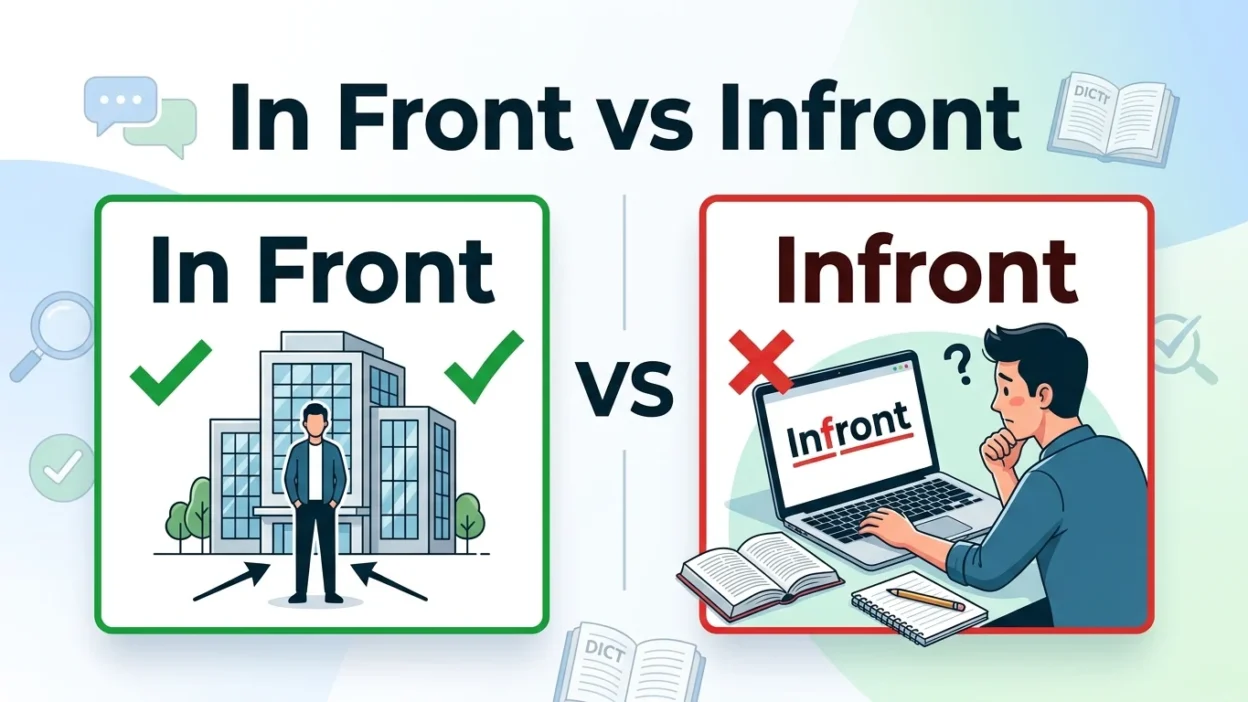
The good news is that the rule is simple. In standard English, in front is the correct expression, while infront is considered a misspelling.
In this guide, you’ll learn the difference between in front vs infront, discover why people confuse them, see plenty of real-life examples, and pick up easy memory tricks to avoid this common mistake.
Quick Answer
The correct form is in front.
- ✅ In front is a two-word prepositional phrase meaning ahead of someone or something.
- ❌ Infront is not a correct spelling in standard English.
Correct:
- The car is parked in front of the house.
Incorrect:
- The car is parked infront of the house.
Whenever you want to describe a position ahead of something, always write in front as two separate words.
What Does “In Front” Mean?
In front is a prepositional phrase that describes the position of a person, object, or place that is ahead of another person or object.
It is commonly followed by of.
Examples include:
- in front of the house
- in front of the school
- in front of the audience
- in front of the camera
This expression is widely used in both spoken and written English.
Examples of In Front
- The children stood in front of the teacher.
- Park your bicycle in front of the garage.
- She sat in front of me during the movie.
- The restaurant is in front of the park.
- He spoke confidently in front of hundreds of people.
Each example shows someone or something positioned ahead of another person or object.
What Does “Infront” Mean?
The answer is simple.
Infront is not a standard English word.
Although it occasionally appears online, it is considered a spelling mistake rather than an accepted variation.
Modern dictionaries, grammar guides, and style manuals recognize only:
✅ In front
Not:
❌ Infront
If you’re writing an essay, email, blog post, or business document, always use the two-word form.
In Front vs Infront: Comparison Table
| Feature | In Front | Infront |
|---|---|---|
| Correct spelling | ✅ Yes | ❌ No |
| Number of words | Two | One |
| Meaning | Ahead of someone or something | None in standard English |
| Used in formal writing | Yes | No |
| Dictionary recognized | Yes | No |
| Everyday English | Standard | Misspelling |
Why Is “In Front” Correct?
The phrase in front is made up of:
- In (a preposition)
- Front (a noun)
Together, they form the fixed expression:
In front of
Unlike compound words such as:
- Inside
- Outside
- Into
- Upstairs
In front has remained two separate words throughout modern English.
This is simply one of the conventions of English spelling.
Why Do People Write “Infront”?
There are several reasons.
1. Compound Word Confusion
English contains many words that combine into one.
For example:
- Inside
- Outside
- Throughout
- Into
Because of this pattern, many learners naturally assume infront should also be one word.
2. Fast Typing
Typing quickly often causes people to remove the space accidentally.
3. Autocorrect Limitations
Some devices fail to flag infront, allowing the mistake to go unnoticed.
4. Influence from Other Languages
Some languages write equivalent expressions as one word, leading learners to transfer that spelling into English.
When Should You Use “In Front”?
Use in front whenever you describe position or location.
Common Situations
- Directions
- Maps
- Buildings
- Seating arrangements
- Public speaking
- Photography
- Vehicles
- Schools
- Events
Correct Examples
- Wait in front of the library.
- She parked in front of my office.
- The bus stopped in front of the station.
- We took a picture in front of the museum.
- He stood in front of the class.
In Front vs Before
Many learners also confuse in front of with before.
Although both can indicate position, they are not always interchangeable.
In Front Of
Refers mainly to physical location.
Example:
- The car is in front of the house.
Before
Usually refers to time, order, or sequence.
Example:
- Finish your homework before dinner.
However, before can occasionally describe physical position in formal or literary English.
Example:
- The king stood before the crowd.
In everyday English, in front of is much more natural for describing location.
Common Mistakes to Avoid
Here are the most frequent errors.
1. Writing Infront
❌ Infront of the building.
✅ In front of the building.
2. Forgetting “Of”
The complete expression is:
In front of
Not simply:
❌ In front the school.
Correct:
✅ In front of the school.
3. Confusing Position with Time
Incorrect:
❌ I arrived in front 8 a.m.
Correct:
✅ I arrived before 8 a.m.
4. Using It as One Word in Formal Writing
Professional documents, academic essays, and business emails should always use:
In front
Easy Memory Trick
Here’s an easy way to remember.
Think:
You’re IN the FRONT row.
Notice there are two separate words:
- In
- Front
Another trick:
If you can insert another word between them—
“In the front”
—you know they should remain separate.
Related Words and Synonyms
Depending on context, you can replace in front of with:
- Ahead of
- Before
- Facing
- Opposite
- At the front of
- Forward of (nautical)
- Leading
Examples:
- The statue stands ahead of the entrance.
- She sat at the front of the classroom.
These alternatives help make your writing more varied.
American vs British English
There is no spelling difference between American and British English.
Both varieties use:
✅ In front
❌ Infront
Examples:
American English:
- Park in front of the store.
British English:
- Park in front of the shop.
The only difference is vocabulary like store versus shop, not the spelling of in front.
Example Sentences
Correct Examples
- Stand in front of the mirror.
- The school is in front of the hospital.
- We met in front of the station.
- She walked in front of everyone.
- He stood in front of the audience.
Incorrect Examples
- ❌ Infront of the office.
- ❌ She waited infront of me.
- ❌ The bus stopped infront of school.
- ❌ Infront of the camera.
- ❌ He parked infront of my house.
Each sentence should use in front instead.
Why Correct Spelling Matters
Using the correct spelling improves:
- Academic writing
- Professional emails
- Job applications
- Business communication
- Reader confidence
- Search engine optimization
Small spelling mistakes can affect how readers perceive your writing.
Using in front correctly demonstrates strong attention to detail.
FAQs
Which is correct: in front or infront?
In front is correct. Infront is a spelling mistake in standard English.
Is infront a real English word?
No. Dictionaries recognize in front as the correct form.
Why do people write infront?
Because many English compound words are written together, leading people to assume this phrase follows the same pattern.
Is in front always two words?
Yes. In standard English, it is always written as two separate words.
Can I use infront in formal writing?
No. Always use in front in essays, emails, reports, and professional documents.
Is there an American and British spelling difference?
No. Both American and British English use in front.
What is another way to say in front of?
Common alternatives include ahead of, before, at the front of, and opposite, depending on the context.
Summary
Understanding in front vs infront is easy once you know the rule. In front is the only correct spelling in standard English and should always be written as two separate words.
It is a fixed prepositional phrase used to describe something positioned ahead of another person or object. In contrast, infront is not recognized by dictionaries and should be avoided in all types of writing.
If you’re writing an academic paper, a professional email, or a simple text message, using in front correctly will make your English appear more polished and accurate.
Paying attention to small details like spacing can significantly improve your grammar and writing skills.
Actionable Takeaway
Whenever you’re tempted to write infront, pause and remember the complete expression: in front of. Since of naturally follows in front, it becomes easier to remember that in and front must stay as two separate words. Practicing this simple habit will help you avoid this common spelling mistake every time.