If you have ever wondered whether to say which one is you or which one are you, you are dealing with a surprisingly common English grammar question. Both expressions may sound understandable, but they are not used in exactly the same way, and the correct choice depends on what you are asking.
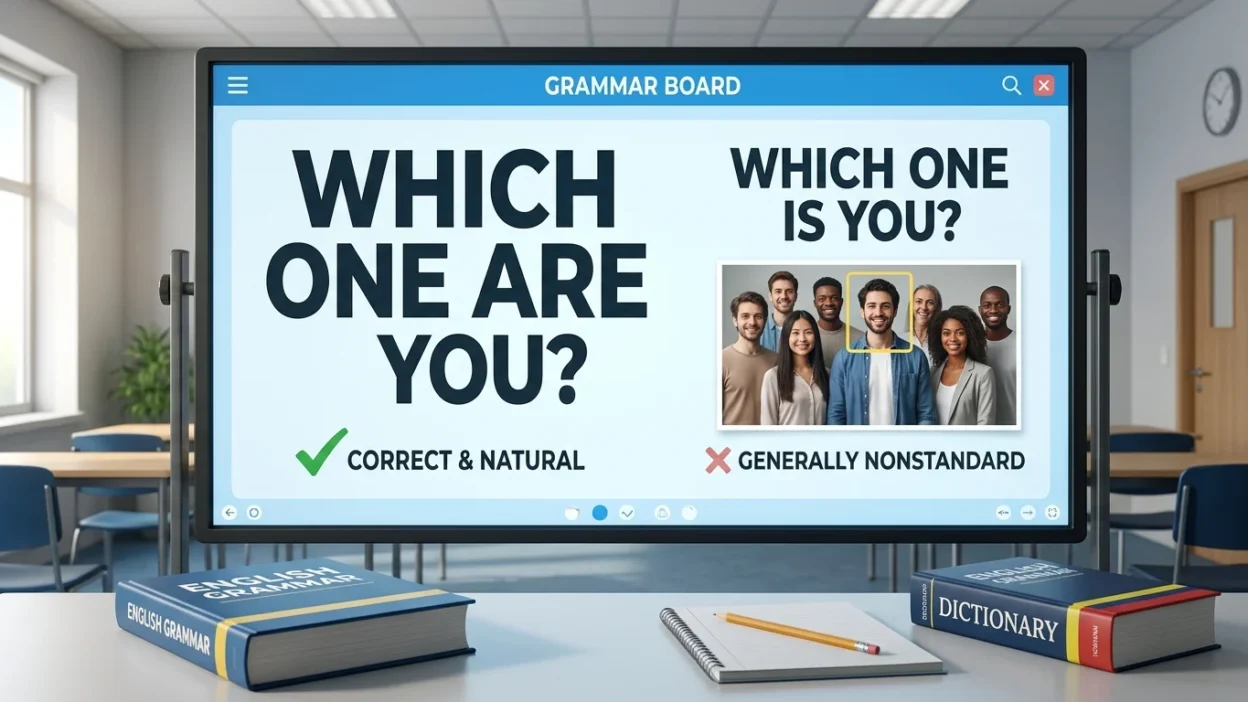
The key is to understand what which one is doing in the sentence. In questions where you is the subject and you are asking someone to identify themselves from a group or selection, which one are you? is normally the natural and grammatically correct form. Which one is you? can appear in informal speech, but it is generally considered nonstandard or awkward in this meaning.
Quick Answer: Which One Is You vs Which One Are You?
The usual and natural question is:
Which one are you?
Use it when asking a person to identify themselves from several people or choices.
Examples:
- Which one are you in the picture?
- Which one are you, John or Ali?
- Which one are you among these students?
- Which one are you talking about?
Simple rule
- Which one are you? → Usually correct when you is the subject.
- Which one is you? → Generally not standard when asking someone to identify themselves.
- Which one is yours? → Correct when asking which item belongs to the person.
- Which one is for you? → Correct when asking which item is intended for the person.
The verb are agrees with the subject you, which is why Which one are you? is the normal construction.
What Does Which One Are You Mean?
Which one are you? is a question used to ask someone to identify themselves from a group, list, photograph, selection, or set of possibilities.
For example, imagine you are looking at a photograph containing five people. You ask someone:
Which one are you?
You are asking the person to point out which person in the photograph is them.
Other examples include:
- Which one are you in this picture?
- Which one are you among these players?
- Which one are you on the team?
- Which one are you in the group photo?
- Which one are you, the teacher or the student?
The phrase can also be used in situations where there are different categories or choices.
Why Is Which One Are You Correct?
The easiest way to understand the grammar is to identify the subject.
In:
Which one are you?
You is the subject, and are agrees with you.
English uses are with the subject you:
- You are happy.
- You are ready.
- You are a teacher.
- Which one are you?
The word which introduces the question, but it does not change the verb agreement with you in this construction.
Compare:
- Which one is he?
- Which one is she?
- Which one are you?
- Which ones are they?
This pattern makes the difference easier to remember.
What About Which One Is You?
Which one is you? can sometimes be heard in casual or nonstandard speech, particularly when a speaker is thinking of you as the object or identity being selected.
However, in standard English, when you are asking someone to identify themselves, Which one are you? is the better construction.
For example:
Less natural/nonstandard:
Which one is you in the photo?
Natural standard English:
Which one are you in the photo?
The second sentence is the form you should normally use in writing and careful speech.
Which One Is You vs Which One Are You: Comparison Table
| Expression | Standard English? | Typical Meaning | Example |
|---|---|---|---|
| Which one are you? | Yes | Asking someone to identify themselves | Which one are you in the picture? |
| Which one is you? | Generally nonstandard in this meaning | Same intended meaning, but awkward | Which one is you in the picture? |
| Which one is yours? | Yes | Asking which item belongs to someone | Which one is yours? |
| Which one is for you? | Yes | Asking which item is intended for someone | Which one is for you? |
The important point is that is and are are not interchangeable here.
Examples of Which One Are You?
Here are some natural examples:
- Which one are you in the family photo?
- Which one are you in this group?
- Which one are you among these players?
- Which one are you, the person in the blue shirt?
- Which one are you in the class picture?
- Which one are you on the list?
- Which one are you in the video?
- Which one are you referring to?
A particularly natural version is:
Which one are you in the picture?
This is commonly used when identifying a person in a photograph.
Which One Are You in a Conversation?
The phrase does not always have to refer to a photograph.
Imagine a teacher has several students in front of them and knows their names but does not know who is who.
The teacher might ask:
Which one are you?
The student can then identify themselves.
It can also be used when someone describes several people:
Ali, Ahmed, and Hamza are all in the picture. Which one are you?
The question asks the person to identify themselves.
Which One Is Yours?
A very common source of confusion is the difference between which one are you and which one is yours.
These questions ask completely different things.
Which one are you?
This asks about the person’s identity.
Which one is yours?
This asks which object belongs to the person.
For example:
- Which phone is yours?
- Which bag is yours?
- Which seat is yours?
- Which car is yours?
Here, yours is a possessive pronoun, so is is correct because which one is the subject.
Compare:
Which one are you? → Who are you among the choices?
Which one is yours? → Which item belongs to you?
Which One Is for You?
Another useful expression is:
Which one is for you?
This asks which object, option, or choice is intended for the person.
For example:
- Which gift is for you?
- Which seat is for you?
- Which package is for you?
- Which meal is for you?
Here, which one is the subject, so is is appropriate.
This gives you an easy comparison:
Which one are you? → You are being identified.
Which one is yours? → Your possession is being identified.
Which one is for you? → Something intended for you is being identified.
Common Mistakes With Which One Is You and Which One Are You
Mistake 1: Using Is With You
One of the most common errors is saying:
Which one is you?
When asking someone to identify themselves, standard English normally uses:
Which one are you?
Remember that you takes are, not is.
Mistake 2: Confusing Identity With Possession
Learners sometimes confuse:
- Which one are you?
- Which one is yours?
The first asks who you are in a group.
The second asks which thing belongs to you.
Mistake 3: Thinking Which One Always Takes Is
The phrase which one does not automatically require is.
The correct verb depends on the grammatical structure.
Examples:
- Which one is yours?
- Which one is better?
- Which one are you?
- Which ones are yours?
Look at the subject and choose the verb accordingly.
Mistake 4: Translating Directly From Another Language
Sometimes learners use which one is you because it follows a structure that feels natural in their first language.
English grammar requires attention to subject-verb agreement, so it is better to learn the complete phrase:
Which one are you?
rather than translating it word by word.
Which One Are You vs Who Are You?
These questions are related but have slightly different uses.
Who are you?
This asks directly about a person’s identity.
Which one are you?
This asks the person to identify themselves from a known group or selection.
For example, if you meet a stranger, you might ask:
Who are you?
But if you are looking at a group photograph, you might ask:
Which one are you?
The word which suggests that there are specific options or possibilities to choose from.
American vs British English Differences
There is no significant American English vs British English difference in the basic grammar of Which one are you?
Both American and British English use:
Which one are you?
when asking someone to identify themselves from a group.
Similarly, both varieties use:
- Which one is yours?
- Which one is better?
- Which one is for you?
- Which one are they talking about?
The grammar is essentially the same.
You may hear nonstandard expressions such as Which one is you? in casual speech, but this is not a standard American-versus-British distinction.
How to Remember the Correct Form
A simple trick is to start with a basic sentence:
You are…
For example:
- You are John.
- You are the person in the blue shirt.
- You are the first person in the picture.
Now turn it into a question:
Which one are you?
The word order changes, but are stays connected with you.
This is similar to:
You are ready.
→ Are you ready?
And:
You are which one?
→ Which one are you?
This simple pattern can help you remember the correct structure.
FAQs
Is which one are you grammatically correct?
Yes. Which one are you? is the standard and natural expression when asking someone to identify themselves from a group or selection.
Is which one is you correct?
Which one is you? is generally considered nonstandard or awkward when asking someone to identify themselves. Which one are you? is the preferred form.
Why do we say which one are you instead of which one is you?
Because you is the subject and the verb are agrees with you. We say you are, not you is.
What is the difference between which one are you and which one is yours?
Which one are you? asks someone to identify themselves. Which one is yours? asks which object belongs to them.
Can I say which one are you in a picture?
Yes. Which one are you in the picture? is a natural and common way to ask someone to identify themselves in a photograph.
Is which one are you American or British English?
It is correct in both American and British English. There is no significant regional difference in this structure.
Can which one are you refer to something other than a picture?
Yes. It can refer to a group, team, list, category, or selection of people or identities.
What is another way to say which one are you?
Depending on the context, you could say Which person are you?, Who are you in the picture?, or Which person in the group are you?
Final Summary
When comparing which one is you vs which one are you, the standard choice for asking someone to identify themselves is which one are you? The reason is simple: you takes the verb are. This question is especially useful when identifying a person in a photograph, group, team, class, or other selection.
Which one is you? may be heard in informal or nonstandard speech, but it is not the preferred construction in standard English. Also remember that which one is yours? and which one is for you? are perfectly correct because their grammatical structures are different.

Liam James is a language enthusiast and content writer at Verseslay, specializing in word comparisons, grammar debates, and vocabulary insights. He helps readers understand language nuances through clear, engaging, and practical explanations.