
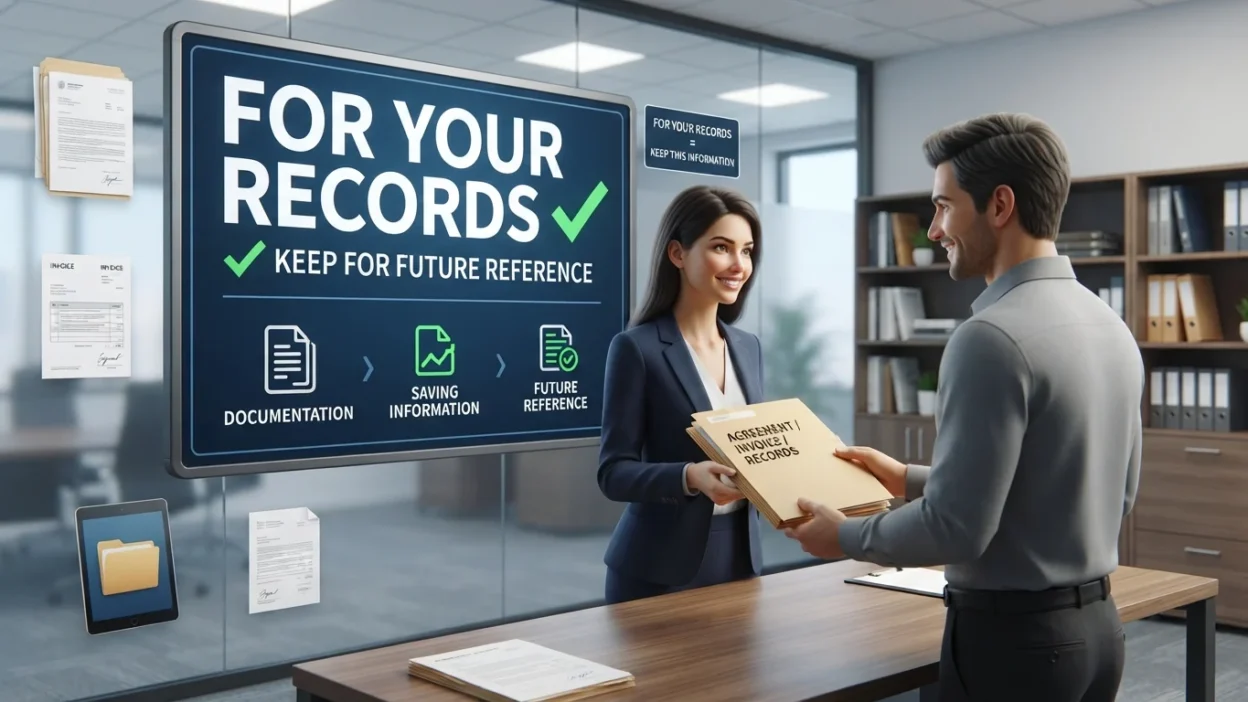
Have you ever received an email that says something is being sent for your records? If you are unsure whether this means you need to do something, keep a copy, or simply be aware of the information, you are not alone. This phrase is extremely common in emails, letters, business communication, and official documents.
For your records generally means that information or a document is being provided so you can keep it for future reference, documentation, or proof. Usually, it does not mean that you need to take immediate action. Understanding this small but useful phrase can make professional English much easier to follow.
Quick Answer
For your records means for you to keep and refer to later if needed.
For example:
- I am sending you a copy of the invoice for your records.
- Please keep this letter for your records.
- Attached is the completed form for your records.
In simple English, for your records = keep this information for future reference.
What Does For Your Records Mean?
The phrase for your records is commonly used when someone gives you a document, email, receipt, statement, confirmation, or other information that you may need to keep.
The word records refers to information that is saved or maintained as evidence, documentation, or a history of something.
When someone says:
I am sending this document for your records.
They usually mean:
I am giving you this document so you can save it and refer to it in the future.
The phrase is especially common in professional and administrative communication.
For Your Records Meaning in Simple English
Here are some easy ways to understand the phrase:
- Keep this for future reference.
- Save this document.
- Keep this information in your files.
- Hold on to this for your records.
- Keep this as documentation.
- Save this in case you need it later.
It is often simply a polite way of telling someone that the information is being provided for documentation rather than immediate action.
Does For Your Records Mean You Need to Do Something?
Usually, no.
This is one of the most important points about the phrase.
If an email says:
Attached is your payment receipt for your records.
The sender is generally not asking you to pay again or respond. They are simply giving you a copy to keep.
However, context matters. If the same email contains another instruction, you should follow that instruction separately.
For example:
Please sign the attached form and return it by Friday. A copy is also included for your records.
Here, signing and returning the form is the required action. The phrase for your records simply explains why you are being given a copy.
Examples of For Your Records
Example 1: Business Email
Attached is a copy of the agreement for your records.
This means the recipient should keep the agreement for future reference.
Example 2: Payment
Please find your payment receipt attached for your records.
The receipt serves as documentation of the payment.
Example 3: Employment
We are sending you a copy of your employment letter for your records.
The employee should save the document.
Example 4: School
Please keep a copy of your admission confirmation for your records.
The student may need the confirmation later.
Example 5: Medical Administration
A copy of your appointment confirmation is attached for your records.
The recipient is being given the document as a reference.
Example 6: Customer Service
We have processed your refund. The transaction details are included below for your records.
The information provides documentation of the refund.
Example 7: Official Communication
Please retain this notice for your records.
This is a slightly more formal way of telling someone to keep the notice.
For Your Records vs For Your Reference
These phrases are similar, but there is a small difference in emphasis.
| Phrase | Meaning | Main Focus |
|---|---|---|
| For your records | Keep as documentation | Saving information |
| For your reference | Keep or consult for information | Future consultation |
| For your information | Giving information for awareness | Knowing something |
| For your files | Keep in your stored documents | Filing/documentation |
| For future reference | Keep and use later | Later use |
| For example: | ||
| I am sending the invoice for your records. | ||
| This emphasizes keeping the invoice. | ||
| I am sending the guide for your reference. | ||
| This emphasizes using the guide later if needed. |
For Your Records vs For Your Information
These two expressions are particularly easy to confuse.
For your records means you should keep the information.
For your information generally means the information is being provided so you are aware of it.
Compare:
The receipt is attached for your records.
Keep the receipt.
For your information, the meeting has been moved to Monday.
The sender simply wants you to know about the change.
The difference is small but useful in professional communication.
Is For Your Records Formal?
Yes, for your records is generally considered professional and moderately formal.
It is perfectly natural in:
- Business emails
- Official letters
- Workplace communication
- Financial documents
- School administration
- Legal correspondence
- Customer service
- Government communication
It can also appear in everyday communication when someone wants another person to keep a document.
For a casual conversation, you might simply say:
Keep this in case you need it later.
For professional communication, for your records sounds concise and appropriate.
Common Mistakes With For Your Records
Mistake 1: Thinking It Means Immediate Action
Receiving something for your records usually does not mean you have to respond.
Always check the rest of the message for separate instructions.
Mistake 2: Confusing Records With References
Records are generally documents or information kept as documentation.
A reference is something you may consult for information.
The meanings overlap, but they are not always identical.
Mistake 3: Assuming It Means the Document Is Officially Required
Something sent for your records does not automatically mean you are legally required to keep it.
The phrase simply indicates that the sender recommends or intends for you to retain the information.
Specific legal or administrative requirements depend on the situation.
Mistake 4: Using the Phrase Without a Clear Context
In a professional email, it is helpful to identify what is being sent.
Instead of:
This is for your records.
You can write:
Attached is a copy of your invoice for your records.
This is clearer and more useful.
Mistake 5: Confusing Your Records With Our Records
The possessive word matters.
For your records means the recipient should keep it.
For our records means the sender or organization is keeping it.
For example:
Please provide a copy for our records.
The organization wants to retain the copy.
How to Use For Your Records in an Email
The phrase is particularly useful when sending attachments or documents.
Common patterns include:
- Attached is ___ for your records.
- Please find attached ___ for your records.
- I am sending ___ for your records.
- Please retain ___ for your records.
- A copy is included for your records.
Examples:
Attached is a copy of the signed agreement for your records.
Please find the payment receipt attached for your records.
A copy of the completed application is included for your records.
These sentences are clear, professional, and natural.
Is It Correct to Say For Your Record?
The standard expression is usually for your records, with the plural noun.
For example:
I am sending this document for your records.
The plural form is natural because a person’s records can consist of multiple documents or pieces of information.
You may encounter for the record as well, but that is a different expression.
For the record usually means that something is being officially stated or clarified.
For example:
For the record, I never approved that decision.
This does not mean keep the document. It means the speaker wants something clearly stated or documented.
For Your Records vs For the Record
These phrases look similar but have different meanings.
For your records means keep this information for future reference.
For the record means to make something officially clear or documented.
Compare:
I am sending you the report for your records.
The recipient should keep the report.
For the record, I did not approve the report.
The speaker is making their position clear.
This distinction is especially important for English learners.
American vs British English
There is no significant difference between American and British English in the meaning or use of for your records.
The phrase is natural in both varieties and appears regularly in professional correspondence.
You may see similar alternatives in both American and British English, including:
- For your reference
- For your files
- Please retain this
- For future reference
British business writing may sometimes use please retain or for your reference, while American business communication also frequently uses for your records. These are style preferences rather than strict grammar differences.
Synonyms and Related Phrases
Depending on the context, you can use:
- For your reference
- For your files
- For future reference
- Please retain this
- Keep this for future use
- Keep this on file
- For documentation purposes
- For your information
Remember that these phrases are not always exact synonyms.
For your records emphasizes keeping documentation, while for your information emphasizes awareness.
Why Is For Your Records So Common in Professional English?
Professional communication often involves documents that people may need to find later. Receipts, contracts, invoices, confirmations, reports, applications, and notices can all serve as records.
The phrase provides a simple way to explain why a document has been shared.
It also avoids unnecessary instructions. Instead of writing a long explanation, a sender can simply say that the document is being provided for the recipient’s records.
This makes the phrase useful in business, administration, finance, education, and many other settings.
FAQs
What does for your records mean?
For your records means that you should keep the information or document so you can refer to it later if necessary.
Does for your records mean I need to reply?
Usually, no. The phrase normally means that you should keep the information. If a response or other action is required, the sender will usually state that separately.
What is another way to say for your records?
You can say for your reference, for your files, for future reference, or please retain this, depending on the context.
What is the difference between for your records and for your information?
For your records focuses on keeping documentation, while for your information mainly means that the recipient is being given information for awareness.
Is for your records formal?
Yes. It is a professional and moderately formal expression commonly used in emails, letters, business communication, and official documents.
Is for your records grammatically correct?
Yes. For your records is a standard and widely used English expression.
What does please retain this for your records mean?
It means that the recipient should keep the document or information for future reference or documentation.
What is the difference between for your records and for the record?
For your records means keep something for future reference. For the record means to state or establish something clearly, often as an official point.
Summary
For your records is a common professional phrase meaning that a document, message, receipt, or piece of information is being provided for you to keep and refer to later. It is particularly common when people exchange important documents such as invoices, agreements, confirmations, reports, and official notices.
The phrase usually does not require immediate action. However, always read the complete message because the sender may include separate instructions. Understanding the difference between for your records, for your reference, and for your information can help you communicate more precisely and confidently in professional English.
Actionable Takeaway
Whenever you see for your records, think keep this for future reference. If someone sends you a document with this phrase, save it somewhere you can easily find it later.
When writing professional emails, you can naturally use Attached is a copy of the document for your records when you want the recipient to keep a copy. It is short, clear, polite, and widely understood in both American and British English.