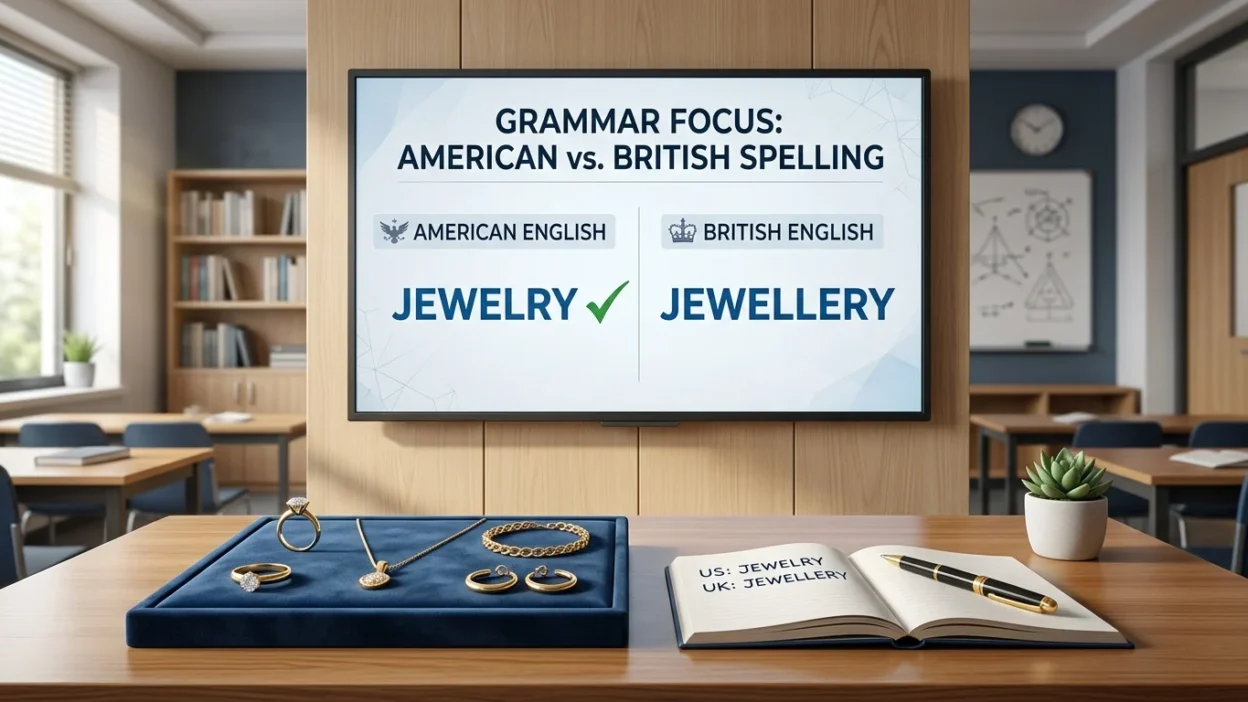
If you have ever wondered whether jewelry or jewellery is the correct spelling, you are not alone. Both forms are correct, but the spelling you should use depends mainly on the variety of English you are writing in. The difference is not about meaning, pronunciation, or quality—it is primarily a matter of regional spelling.
Jewelry is the standard spelling in American English, while jewellery is the traditional spelling used in British English and several other varieties of English. Once you know this simple distinction, choosing the right form becomes much easier.
Quick Answer
Jewelry and jewellery have exactly the same meaning. They refer to decorative items worn on the body, such as rings, necklaces, bracelets, earrings, and brooches.
- Jewelry = American English
- Jewellery = British English
- Both spellings are correct.
- The pronunciation is essentially the same.
- The choice depends on your target audience and preferred English style.
Example:
American English: She bought a beautiful piece of jewelry.
British English: She bought a beautiful piece of jewellery.
Jewelry vs Jewellery: What Is the Difference?
The main difference between jewelry and jewellery is regional spelling.
American English generally simplifies the spelling to jewelry, dropping the extra letters found in the British form. British English retains jewellery, which follows the traditional spelling pattern.
The two words do not have different definitions. Whether you write jewelry or jewellery, you are talking about decorative objects made from materials such as gold, silver, platinum, diamonds, pearls, and other precious or semiprecious stones.
So, if someone asks whether jewelry and jewellery mean different things, the answer is no.
What Does Jewelry Mean?
Jewelry is the American English spelling for decorative items worn as personal adornment.
Common examples include:
- Rings
- Necklaces
- Earrings
- Bracelets
- Brooches
- Pendants
- Anklets
- Cufflinks
- Charms
- Watches with decorative elements
For example:
She received a beautiful diamond ring as a gift.
In American English, you could describe the ring as a piece of jewelry.
The word can refer to one item or a collection of decorative items.
What Does Jewellery Mean?
Jewellery is the British English spelling of the same word.
It has exactly the same meaning as jewelry and refers to decorative objects worn for personal adornment.
For example:
She inherited a valuable piece of jewellery from her grandmother.
This spelling is common in the United Kingdom and is also used in other English-speaking regions influenced by British English.
If you are writing for a British audience, jewellery is usually the spelling you should choose.
Jewelry vs Jewellery Examples
Seeing both forms in context makes the difference much clearer.
American English Examples
- She loves buying handmade jewelry.
- The jewelry store is located downtown.
- He gave her a gold necklace as a piece of jewelry.
- The museum has an impressive jewelry collection.
- She designs custom jewelry for weddings.
British English Examples
- She loves buying handmade jewellery.
- The jewellery shop is located in the city centre.
- He gave her a gold necklace as a piece of jewellery.
- The museum has an impressive jewellery collection.
- She designs custom jewellery for weddings.
Notice that the meaning stays exactly the same. Only the spelling changes.
Jewelry or Jewellery: Which One Should You Use?
The best spelling depends on your audience.
If you are writing primarily for readers in the United States, use jewelry.
If your audience is mainly in the United Kingdom, use jewellery.
For example, an American jewelry website might use phrases such as:
- Fine jewelry
- Jewelry store
- Jewelry designer
- Jewelry collection
- Custom jewelry
A British website would generally use:
- Fine jewellery
- Jewellery shop
- Jewellery designer
- Jewellery collection
- Custom jewellery
The important thing is to remain consistent. Switching randomly between American and British spelling can make your writing look less polished.
American English vs British English
The difference between jewelry and jewellery is part of a larger pattern of spelling differences between American and British English.
Here are some familiar examples:
| American English | British English |
|---|---|
| jewelry | jewellery |
| color | colour |
| favorite | favourite |
| honor | honour |
| center | centre |
| theater | theatre |
| traveler | traveller |
These differences usually do not change the meaning of the words. They simply reflect different spelling conventions.
If your website follows American English, use jewelry consistently. If it follows British English, use jewellery consistently.
Is Jewelry or Jewellery More Correct?
Neither spelling is inherently more correct.
Jewelry is correct in American English, while jewellery is correct in British English. The appropriate choice depends on the variety of English you are using.
This is an important point because people sometimes assume that one spelling is a misspelling of the other. It is not.
For example, a writer in the United States would normally write:
I bought some new jewelry.
A British writer would normally write:
I bought some new jewellery.
Both sentences are grammatically correct.
Common Mistakes With Jewelry vs Jewellery
Although the spelling difference is simple, several mistakes are common.
1. Treating One Spelling as Incorrect
A common mistake is assuming that jewellery is misspelled because American English uses jewelry.
Both forms are standard. The difference is regional.
2. Mixing Spelling Styles
Another common problem is mixing American and British spelling in the same piece of writing.
For example, using jewelry, colour, and centre together may create an inconsistent style if you are trying to follow one variety of English.
Choose one style and stick with it.
3. Using Jewelry for a British Audience
If you are writing specifically for British readers, jewellery is generally the expected spelling.
This matters particularly for businesses, product descriptions, blogs, and online stores that want their language to match their target market.
4. Assuming the Pronunciation Is Different
The spelling changes, but the pronunciation is essentially the same.
You do not need to pronounce the two forms as completely different words.
5. Confusing Jewelry With a Specific Type of Item
Jewelry/jewellery is a general term. A ring, necklace, bracelet, or pair of earrings can all be described as jewelry or jewellery.
For example:
That necklace is beautiful.
The necklace is a specific item, while jewelry is the broader category.
Jewelry vs Jewellery in Business and SEO
If you are writing online, spelling can also matter for consistency and audience targeting.
An American-focused website might naturally use keywords such as:
- jewelry store
- jewelry designer
- gold jewelry
- silver jewelry
- handmade jewelry
- fine jewelry
- jewelry collection
A British-focused website might use:
- jewellery shop
- jewellery designer
- gold jewellery
- silver jewellery
- handmade jewellery
- fine jewellery
- jewellery collection
Search engines can understand that jewelry and jewellery are closely related variants, but using the spelling naturally preferred by your target audience can make your content feel more relevant and authentic.
The most important SEO principle is not to force both spellings repeatedly. Write naturally, provide useful information, and maintain a consistent language style.
Jewelry vs Jewellery: A Simple Memory Trick
Here is an easy way to remember the difference:
Jewelry = American English
Jewellery = British English
You can also remember that British English often keeps extra letters in words such as colour, favourite, and jewellery, while American English tends to use shorter spellings such as color, favorite, and jewelry.
Once you associate jewelry with American English and jewellery with British English, the choice becomes much easier.
FAQs
Is jewelry and jewellery the same thing?
Yes. Jewelry and jewellery have the same meaning. Both refer to decorative items such as rings, necklaces, bracelets, and earrings. The main difference is regional spelling.
Is jewelry American or British English?
Jewelry is the standard spelling in American English. British English generally uses jewellery.
Is jewellery British English?
Yes. Jewellery is the traditional standard spelling in British English and is also common in other varieties influenced by British English.
Which spelling should I use in the USA?
Use jewelry when writing for an American audience. For example, fine jewelry and jewelry store are standard American forms.
Which spelling should I use in the UK?
Use jewellery when writing for a British audience. Common expressions include fine jewellery and jewellery shop.
Is jewelry a spelling mistake?
No. Jewelry is the standard American English spelling and is completely correct.
Is jewellery a spelling mistake?
No. Jewellery is the standard British English spelling and is completely correct.
Does jewelry have a different pronunciation from jewellery?
No significant pronunciation difference is intended. The two spellings represent the same word and meaning.
Summary
The choice between jewelry vs jewellery is straightforward once you understand the regional difference. Jewelry is the standard American English spelling, while jewellery is the standard British English spelling. Both words refer to decorative items such as rings, necklaces, bracelets, earrings, and other personal adornments.
There is no difference in meaning or correctness. The key is to consider your audience and remain consistent throughout your writing. If you are targeting American readers, choose jewelry; if you are targeting British readers, choose jewellery. This simple distinction will help your writing sound natural and professionally tailored to your audience.

Liam James is a language enthusiast and content writer at Verseslay, specializing in word comparisons, grammar debates, and vocabulary insights. He helps readers understand language nuances through clear, engaging, and practical explanations.