
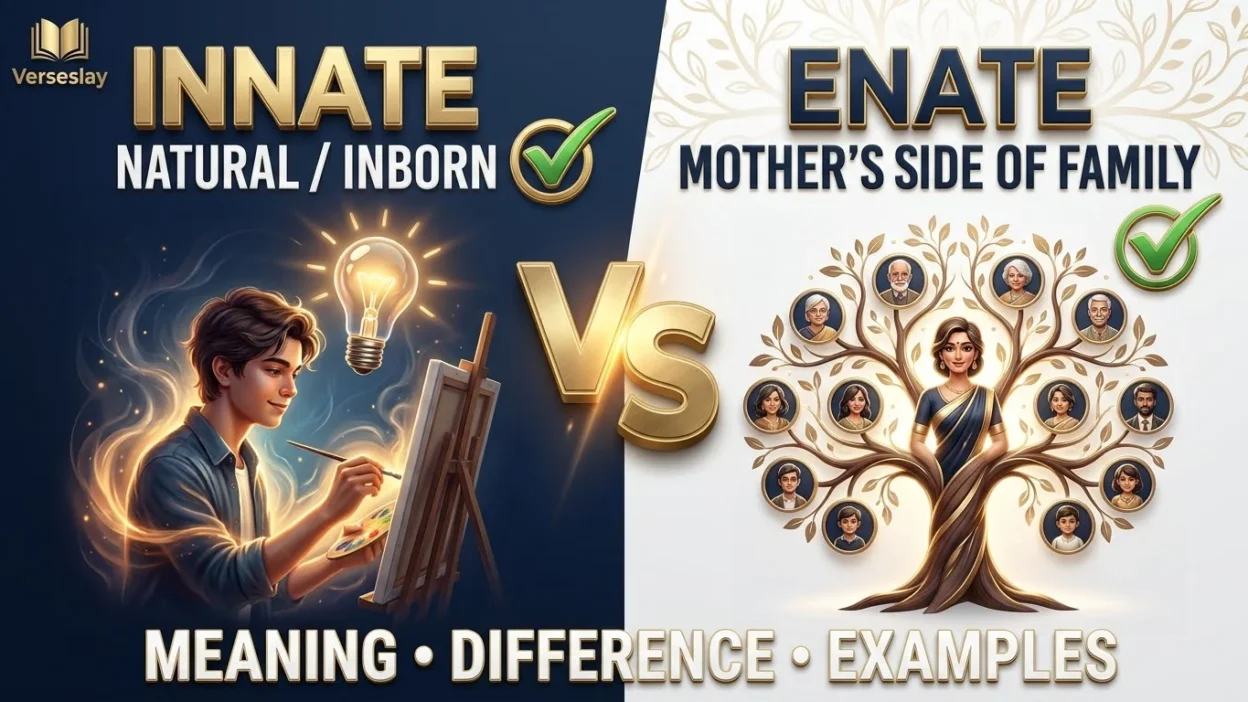
Have you ever come across the words innate and enate and wondered whether they mean the same thing? They look and sound similar, but their meanings are quite different. One is commonly used in everyday English, while the other is a specialized term found mainly in genealogy and biological classification.
Understanding the difference between innate vs enate can help you choose the correct word when writing essays, articles, academic papers, or professional documents. In this guide, you will learn the definitions of both words, see practical examples, discover common mistakes, and understand when each term is appropriate.
Quick Answer: Innate vs Enate
Innate means natural, inborn, or present from birth rather than acquired through learning or experience. It is widely used in everyday English.
Enate is a much less common term that means related through the mother’s side of a family. It is primarily used in genealogy and technical discussions of kinship.
Examples:
- Innate: She has an innate ability to understand music.
- Enate: The researcher documented his enate relatives in the family history.
Remember: Use innate when talking about natural qualities or abilities. Use enate when referring specifically to maternal family relationships.
What Does Innate Mean?
The adjective innate describes a quality, ability, characteristic, or tendency that is natural or inborn rather than developed entirely through education, practice, or experience.
Something innate may be present from birth or arise from a person’s or organism’s natural constitution. However, calling a trait innate does not always mean that it is fully developed at birth or that experience cannot influence it.
The word is commonly used in psychology, biology, education, philosophy, and everyday conversation.
Examples of Innate in Sentences
- The child has an innate curiosity about the world.
- She possesses an innate talent for drawing.
- Some animals have an innate ability to recognize certain dangers.
- His innate kindness makes him a wonderful friend.
- Researchers study whether certain behaviors are innate or learned.
- The teacher recognized her student’s innate potential.
- Humans have an innate capacity to learn language, although experience plays a crucial role in language development.
In each example, innate refers to a natural quality, tendency, or capacity rather than something acquired solely through training.
Synonyms of Innate
Depending on the context, synonyms for innate include:
- Inborn
- Natural
- Inherent
- Instinctive
- Ingrained
- Inbred
- Intrinsic
These words are related but are not always interchangeable. For example, instinctive often describes an automatic response, while inherent emphasizes a quality that belongs naturally to something.
What Does Enate Mean?
Enate is a rare adjective that refers to a relationship through the mother’s side of a family. It is mainly used in genealogy, historical writing, and specialized discussions of kinship.
For example, if someone traces their family connections through their mother, they may describe relatives connected through that maternal line as enate relatives.
The word is not commonly used in everyday conversation. Most people would say “relatives on my mother’s side” because the meaning is clearer and more familiar.
Examples of Enate in Sentences
- The historian examined the family’s enate connections.
- Her enate relatives helped preserve the family’s historical records.
- The genealogist traced several enate branches of the family tree.
- The document distinguished between relatives on the father’s side and enate relatives on the mother’s side.
- The researcher studied the enate line to understand the family’s maternal ancestry.
These examples illustrate the specialized use of enate. In ordinary writing, a simpler phrase such as “maternal relatives” will usually be easier for readers to understand.
Synonyms and Related Terms for Enate
The closest everyday alternatives include:
- Maternal
- Related through the mother’s side
- From the maternal line
- On the mother’s side of the family
The word maternal is generally the most useful alternative in everyday English. However, enate has a specific genealogical sense, so the exact replacement depends on the sentence.
Innate vs Enate: Key Differences
Although these words look similar, they differ in meaning, usage, and frequency.
| Feature | Innate | Enate |
|---|---|---|
| Meaning | Natural or inborn | Related through the mother’s side |
| Part of speech | Adjective | Adjective |
| Common usage | Everyday and academic English | Specialized genealogical usage |
| Main context | Abilities, qualities, tendencies, characteristics | Maternal ancestry and family relationships |
| Common example | Innate talent | Enate relatives |
| Frequency | Common | Rare |
| Everyday alternative | Inborn, natural, inherent | Maternal, relatives on the mother’s side |
The most important distinction is that innate describes a natural characteristic, while enate describes a type of family relationship.
How to Remember the Difference Between Innate and Enate
If you often confuse these words, a simple memory trick can help.
Innate = Inborn
Both words are associated with something natural or present from birth. Think of an innate talent as a talent that comes naturally to someone.
Enate = Maternal relatives
Connect enate with a family tree and the mother’s side. When discussing maternal ancestry or relatives connected through the mother, enate may be the appropriate technical term.
Here is an easy comparison:
- A person may have an innate musical ability.
- That person’s enate relatives are connected through the mother’s side of the family.
Remembering these two examples will help you distinguish the words quickly.
Common Mistakes When Using Innate and Enate
1. Using Enate When You Mean Innate
Incorrect: She has an enate ability to solve problems.
Correct: She has an innate ability to solve problems.
The sentence refers to a natural ability, so innate is the correct word.
2. Using Innate to Describe Maternal Relatives
Incorrect: He invited all his innate relatives to the family reunion.
Correct: He invited all his enate relatives to the family reunion.
Here, the intended meaning concerns relatives connected through the mother’s side. In everyday writing, “relatives on his mother’s side” would be even clearer.
3. Assuming the Words Are Different Spellings of the Same Term
Innate and enate are not American and British spelling variations. They are separate words with different meanings.
You should not replace one with the other simply because they look or sound similar.
4. Using Enate in Casual Conversation Without Explanation
Because enate is rare, readers may not recognize it.
Instead of writing, “My enate relatives are visiting,” you could write, “My relatives on my mother’s side are visiting.”
Choose the specialized word when precision is important and your audience understands the terminology.
5. Assuming Innate Means Entirely Unchangeable
An innate tendency or ability is not necessarily fixed forever. Natural characteristics can interact with learning, environment, and experience.
For example, someone may have an innate aptitude for music, but practice and education can still influence their musical skills.
Is Innate or Enate Correct?
Both innate and enate are correct English words, but they are used in different situations.
Choose innate when describing something natural or inborn:
- An innate sense of responsibility
- Innate curiosity
- An innate ability to recognize patterns
Choose enate when discussing relatives or ancestry connected through the mother’s side:
- Enate relatives
- Enate family connections
- An enate line of descent
If you are writing a general essay, email, story, or everyday message, you will probably need innate. If you are writing about genealogy or maternal kinship, enate may be appropriate.
American vs British English: Innate vs Enate
There is no meaningful American-versus-British spelling difference between these words. Both innate and enate retain the same spelling and basic meanings in American and British English.
The main difference is how frequently they are used. Innate is widely recognized in both varieties, while enate is uncommon and mainly appears in specialized contexts.
For example, an American or British writer might naturally write, “She has an innate sense of fairness.” In a genealogical text, either writer could use enate to describe a relationship through the maternal line.
For general audiences in either country, “relatives on the mother’s side” is often clearer than enate relatives.
FAQs
1. What is the main difference between innate and enate?
Innate means natural or inborn, while enate refers to a relationship through the mother’s side of a family. They are different words, not alternative spellings.
2. Is enate a real English word?
Yes. Enate is a legitimate but rare English adjective used mainly in genealogy and discussions of family relationships. It refers to the maternal side of a family.
3. Does innate mean present from birth?
Generally, yes. Innate describes a natural or inborn quality, ability, or tendency rather than one acquired solely through learning. It does not necessarily mean that the characteristic is fully developed at birth.
4. What is a synonym for innate?
Common synonyms include inborn, natural, inherent, and intrinsic. The best choice depends on the context and the precise meaning you want to express.
5. What is a synonym for enate?
Maternal is a useful related term. In everyday English, “related through the mother’s side” or “on the mother’s side of the family” is often clearer.
6. Can innate and enate be used interchangeably?
No. They have different meanings. You cannot use enate to describe a natural talent or innate to identify relatives connected through the maternal line.
7. Is innate more common than enate?
Yes. Innate is widely used in ordinary conversation and academic writing. Enate is rare and mostly appears in specialized genealogical or historical contexts.
8. How can I remember innate vs enate?
Remember innate = inborn and enate = maternal family connections. Linking each word to its central meaning makes it easier to choose the correct one.
Summary
The difference between innate and enate comes down to their meanings and contexts. Innate describes a natural, inborn, or inherent quality, such as innate curiosity or innate talent. Enate, on the other hand, is a rare term referring to relatives or relationships connected through the mother’s side of a family. Both words are correct, but they cannot be used interchangeably.
Actionable takeaway: Before choosing between these words, ask yourself what you are describing. If you mean a natural ability, quality, or tendency, use innate. If you mean a relationship through the maternal side of a family, use enate. When writing for a general audience, remember that “inborn” and “relatives on the mother’s side” may communicate your meaning more clearly.