
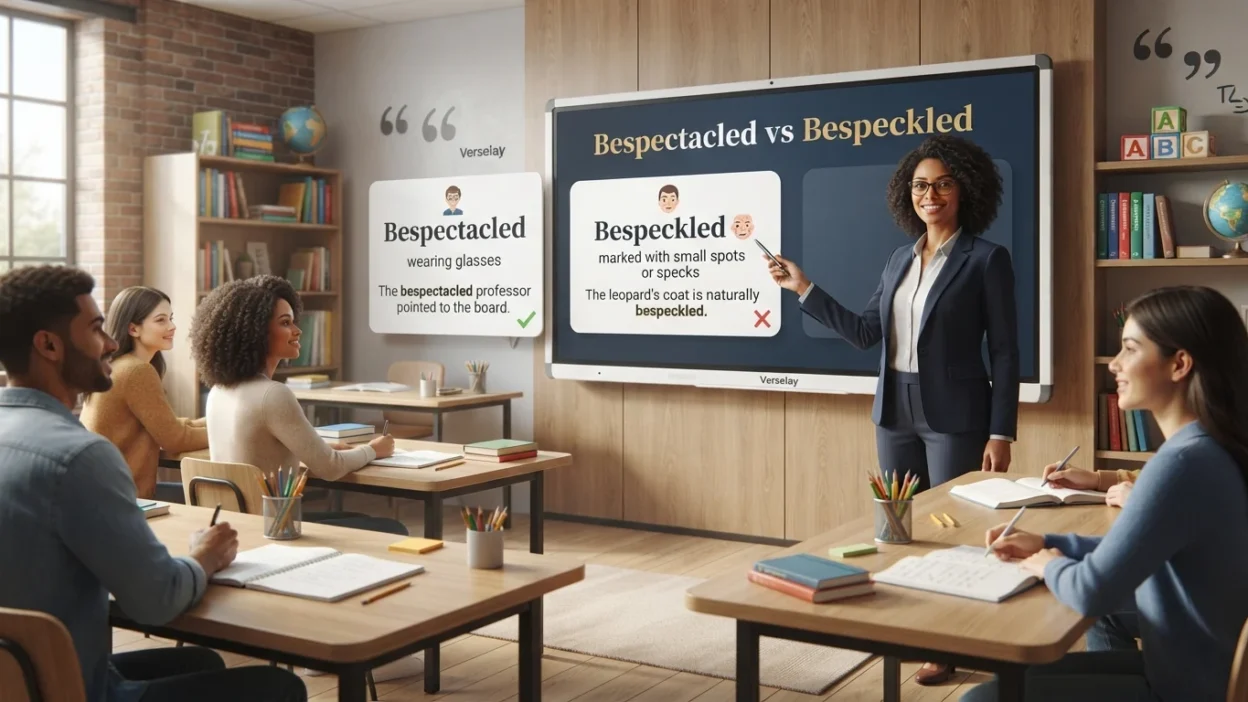
Bespectacled vs bespeckled may look and sound somewhat similar, but these two English words have completely different meanings. Because both words begin with “bespec-”, it is easy to confuse them, especially when you are reading quickly or trying to describe someone’s appearance.
The good news is that the difference becomes simple once you connect each word with its meaning. Bespectacled describes someone who wears glasses, while bespeckled means covered or marked with many small spots or specks. In this guide, we will explore the meanings, pronunciation, examples, common mistakes, and American vs British English usage of bespectacled vs bespeckled.
Quick Answer: Bespectacled vs Bespeckled
The simplest way to remember the difference is:
- Bespectacled = wearing glasses or spectacles
- Bespeckled = covered or marked with small spots or specks
Examples
This means the teacher was wearing glasses.
This means the wall was covered with small spots.
Easy memory trick
Think of:
Bespectacled → spectacles → glasses
Bespeckled → specks → small spots
This connection makes it much easier to remember which word to use.
What Does Bespectacled Mean?
Bespectacled is an adjective used to describe a person who is wearing glasses or spectacles.
The word comes from spectacles, an older and more formal word for eyeglasses.
For example:
This means:
The word bespectacled is often used to describe someone’s appearance. It can appear in books, journalism, descriptive writing, and everyday language, although wearing glasses is usually more common in casual conversation.
Examples of Bespectacled
- The bespectacled student raised his hand.
- A bespectacled woman answered the phone.
- The journalist interviewed a bespectacled professor.
- The bespectacled scientist explained the experiment.
- I noticed a bespectacled man standing near the door.
- The story featured a clever bespectacled detective.
In each example, bespectacled tells us that the person is wearing glasses.
What Does Bespeckled Mean?
Bespeckled is an adjective meaning covered or marked with many small spots, dots, or specks.
A speck is a very small spot or particle.
Therefore, bespeckled is connected to the idea of being covered with tiny marks.
For example:
This means the sky appeared to have many tiny points of light across it.
Other examples include:
The word can describe physical objects, surfaces, clothing, animals, landscapes, and even the appearance of the sky.
Bespectacled vs Bespeckled: Comparison Table
| Word | Meaning | Related Word | Example |
|---|---|---|---|
| Bespectacled | Wearing glasses | Spectacles | The bespectacled teacher smiled. |
| Bespeckled | Covered with small spots or specks | Speck | The wall was bespeckled with paint. |
| Spectacled | Wearing spectacles or glasses | Spectacles | A spectacled man entered the room. |
| Speckled | Marked with small spots | Speck | The bird had speckled feathers. |
The main difference is the word hidden inside each adjective.
Bespectacled contains the idea of spectacles.
Bespeckled contains the idea of specks.
Bespectacled: Meaning and Examples in Detail
The adjective bespectacled is usually applied to people because people wear glasses.
Here are some examples in different contexts.
Example 1: School
The teacher was wearing glasses.
Example 2: Workplace
The manager had glasses on.
Example 3: Literature
The adjective helps create a visual description of the character.
Example 4: Journalism
Again, the word describes the professor’s appearance.
Example 5: Everyday Description
The woman was wearing glasses.
In casual speech, however, most people would probably say:
This is more conversational and straightforward.
Bespeckled: Meaning and Examples in Detail
Bespeckled is much more closely connected with the idea of small spots or marks.
Example 1: The Sky
The stars looked like tiny bright spots across the sky.
Example 2: Clothing
The shirt had many tiny paint spots on it.
Example 3: Animal
The bird had small spots or markings on its feathers.
Example 4: Surface
The table had many small marks.
Example 5: Face
The face had many small spots or freckles.
In these examples, bespeckled creates a visual image of something covered with small marks.
Bespectacled vs Bespeckled: Common Mistakes
Mistake 1: Using “Bespeckled” for Someone Wearing Glasses
Incorrect:
This does not normally mean the teacher was wearing glasses. Instead, it suggests that the teacher was covered or marked with small spots.
Correct:
Mistake 2: Using “Bespectacled” for a Spotted Object
Incorrect:
This is incorrect because bespectacled relates to glasses.
Correct:
Mistake 3: Confusing “Speckled” and “Bespeckled”
The words speckled and bespeckled are closely related.
For example:
Both can describe an egg with small spots, although speckled is generally more common and natural in everyday English.
Mistake 4: Thinking “Bespectacled” Means “Intelligent”
A person described as bespectacled is simply wearing glasses. The word does not automatically mean the person is intelligent, educated, serious, or scholarly.
However, writers sometimes use the word as part of a character description that may suggest a particular image or personality.
Bespectacled vs Spectacled
Another word you may encounter is spectacled.
Both bespectacled and spectacled can describe someone wearing spectacles or glasses.
For example:
Both can be understood, although bespectacled is often used as a more descriptive adjective in written English.
In everyday conversation, however, the most natural phrase is usually:
This is simpler and more direct.
Bespeckled vs Speckled
Similarly, bespeckled and speckled are related.
Speckled means marked with small spots or specks.
Bespeckled can mean covered or dotted with small spots.
The word speckled is generally more common in everyday English, while bespeckled can sound more literary or descriptive.
Both words can be useful when writing vivid descriptions.
American English vs British English
There is no major difference between American and British English in the basic meanings of bespectacled and bespeckled.
In both varieties:
However, the word spectacles itself is more strongly associated with British English than American English.
In American English, people commonly say:
In British English, people may say:
or, in more formal or traditional contexts:
Because bespectacled comes from spectacles, it may sometimes sound slightly more formal, literary, or old-fashioned than the everyday phrase wearing glasses.
For example:
Common in both varieties:
More descriptive or literary:
The meaning remains the same.
How to Remember Bespectacled vs Bespeckled
The easiest way to remember these words is to focus on the root word.
Bespectacled = Spectacles
Think:
Example:
Bespeckled = Specks
Think:
Example:
This simple word association can prevent most mistakes.
When Should You Use These Words?
Use bespectacled when describing:
- A person wearing glasses
- A character in a story
- A professor or teacher
- A journalist
- A professional
- A fictional character
Use bespeckled when describing something:
- Covered with small spots
- Marked with tiny dots
- Dotted with small particles
- Decorated with scattered marks
Quick examples
People and glasses:
Small spots:
The context makes the difference clear.
FAQs
1. What is the difference between bespectacled and bespeckled?
Bespectacled means wearing glasses or spectacles. Bespeckled means covered or marked with small spots, dots, or specks.
2. Does bespectacled mean someone is wearing glasses?
Yes. Bespectacled is an adjective used to describe someone who is wearing glasses or spectacles.
3. What does bespeckled mean?
Bespeckled means covered or marked with many small spots or specks. For example, a bespeckled surface has many small marks on it.
4. Is bespectacled a common word?
It is a recognized English word, but it is more common in descriptive, literary, journalistic, or formal writing than in everyday conversation. Most people simply say wearing glasses.
5. Is bespeckled the same as speckled?
They have very similar meanings. Both can describe something marked with small spots. Speckled is generally more common in everyday English.
6. Is bespectacled used differently in American and British English?
The basic meaning is the same in both varieties. However, bespectacled may sound somewhat formal or literary, while wearing glasses is more common in everyday American and British English.
7. How can I remember the difference?
Connect bespectacled with spectacles, meaning glasses. Connect bespeckled with specks, meaning small spots.
8. Can I use bespectacled for an object?
Usually, no. Bespectacled is normally used for a person or sometimes an animal wearing glasses. For something covered in small spots, use bespeckled or speckled.
Final Summary
The difference between bespectacled vs bespeckled is easy to understand once you focus on their roots. Bespectacled comes from the idea of spectacles, meaning glasses, so it describes someone who is wearing glasses. Bespeckled, on the other hand, is related to specks, meaning small spots or marks, and describes something covered or marked with them.
Although these words look and sound similar, they belong to completely different semantic categories. If you are describing a person with glasses, choose bespectacled. If you are describing something with many small spots, choose bespeckled. In everyday conversation, simpler expressions such as wearing glasses and speckled may sound more natural, but both bespectacled and bespeckled are useful descriptive words.